










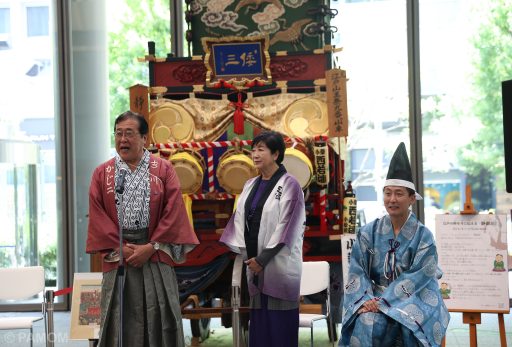
TOKYO — The Tokyo Metropolitan Government officially launched the Edo Tokyo Campaign 2026 Spring on June 12 with an opening ceremony held at Marucube in the Marunouchi Building, bringing together government officials, community leaders, cultural organizations, and members of the public to celebrate the enduring legacy of Edo culture.
The campaign, which will be presented four times throughout 2026 in alignment with the seasons, aims to showcase the traditions, performing arts, craftsmanship, and community spirit that have shaped Tokyo since the Edo period. The inaugural spring edition takes place from June 12 to June 14, primarily across Chiyoda and Sumida wards, and coincides with the historic Sannō Matsuri at Hie Shrine.
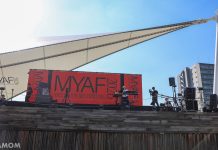
The ceremony opened to the sounds of traditional Ohayashi festival music performed by members of the Kajicho 2-chome Neighborhood Association, whose drums and flutes immediately transformed the modern Marunouchi venue into a celebration of old Edo. The performance framed the event’s central message: preserving and sharing the cultural traditions that continue to define Tokyo’s identity.
Tokyo Governor Yuriko Koike delivered the opening remarks, emphasizing the importance of connecting Tokyo’s past with its future and introducing the city’s cultural heritage to a global audience. She highlighted the role of traditional festivals, local communities, and cultural practitioners in keeping Edo traditions alive while positioning Tokyo as an international destination where history and innovation coexist.
The Governor was joined by Takaaki Higuchi, who spoke about the significance of Chiyoda’s historic neighborhoods and their continuing contribution to preserving local culture. Remarks were also delivered by Masamori Yoshikawa, representing one of the communities actively involved in maintaining and passing down traditional festival culture.
Following the speeches, Governor Koike officially declared the opening of Edo Tokyo Campaign 2026 Spring before participating in a commemorative photo session alongside representatives of the campaign and cultural organizations.
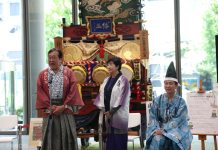
After the ceremony, Governor Koike toured the venue’s cultural displays, viewing traditional exhibits connected to Edo history, including a magnificent Edo-style festival float and displays related to historic festival culture. The exhibits provided visitors with a rare opportunity to experience the scale and artistry of the elaborate floats that once paraded through the streets of Edo.
The cultural program continued after the Governor’s departure, offering media and visitors hands-on opportunities to engage with traditional Edo arts. Members of the Kajicho 2-chome Neighborhood Association introduced participants to the techniques and rhythms of Ohayashi festival music, allowing guests to experience one of the most recognizable sounds of traditional Japanese celebrations.
Visitors also had the opportunity to explore Monkiri, a traditional Edo-period paper-cutting craft used to create decorative crests and symbolic designs. The workshop was led by Nabo Shimonaka, who introduced participants to the history and techniques behind the centuries-old art form.
The opening ceremony served as both a cultural showcase and a statement of intent for the year-long campaign. By combining traditional performances, community participation, educational experiences, and historical exhibits, Edo Tokyo Campaign 2026 Spring demonstrated how the spirit of Edo continues to thrive in contemporary Tokyo.
The campaign’s timing alongside the Sannō Matsuri, one of the historic Tenka Matsuri festivals associated with the Edo period, further reinforces its mission to connect residents and international visitors with the traditions that have shaped the Japanese capital for generations.
Official Links
Edo Tokyo Campaign Official Website
https://edotokyokirari.jp/
Tokyo Tourism Official Website
https://www.gotokyo.org/
Hie Shrine (Sannō Matsuri)
https://www.hiejinja.net
To see more images, please visit:

